← 2026-10-16 edition · Sourced reporting
Published Oct 16, 2026, 3:44 PM Central · This version Oct 16, 2026, 3:44 PM Central · As of 2026-10-16
NASA counts fewer heat-shield char-loss spots after Artemis II
NASA’s October 15 assessment reports nine char-loss spots on Artemis II’s heat shield, versus 103 on Artemis I. The agency credits a changed reentry path. These inspection counts do not measure how much safer a future flight will be. [1] [2]
Read NASA’s assessment, especially the char-loss counts and the paragraph on continuing laser-scan, sample and thermal work. Check which measurement supports any claim about future flight safety. →NASA’s October 15, 2026 post-flight assessment of Orion heat shields after Artemis I and II. Counts are char-loss spots of varying sizes on each heat-shield dish, not damaged area, damaged blocks, failure probability or an independent safety certification. The mission return occurred in April; publication of additional analysis is the fresh development.
- 2 source records
- NASA Communications
- NASA / Erika Peters
Still open: NASA’s two articles are one institutional chain, not independent corroboration. All open questions ↓
Reporting question · As of 2026-10-16
The question: What does NASA’s new Artemis II heat-shield analysis establish about reentry protection—and what remains unmeasured?
NASA’s October 15, 2026 post-flight assessment of Orion heat shields after Artemis I and II. Counts are char-loss spots of varying sizes on each heat-shield dish, not damaged area, damaged blocks, failure probability or an independent safety certification. The mission return occurred in April; publication of additional analysis is the fresh development.
Post-flight inspections of Artemis I and II; NASA assessment published October 15, 2026 · reported char-loss spots per inspected heat-shield dish
One inspected shield per mission. Spots vary in size. These are location counts, not damaged-area percentages, lost mass or safety probabilities.
Read the values and scale as a table
| Measure | Value (reported char-loss spots per inspected heat-shield dish) | Evidence |
|---|---|---|
| Artemis I heat-shield dish | 103 | [1] |
| Artemis II heat-shield dish | 9 | [1] |
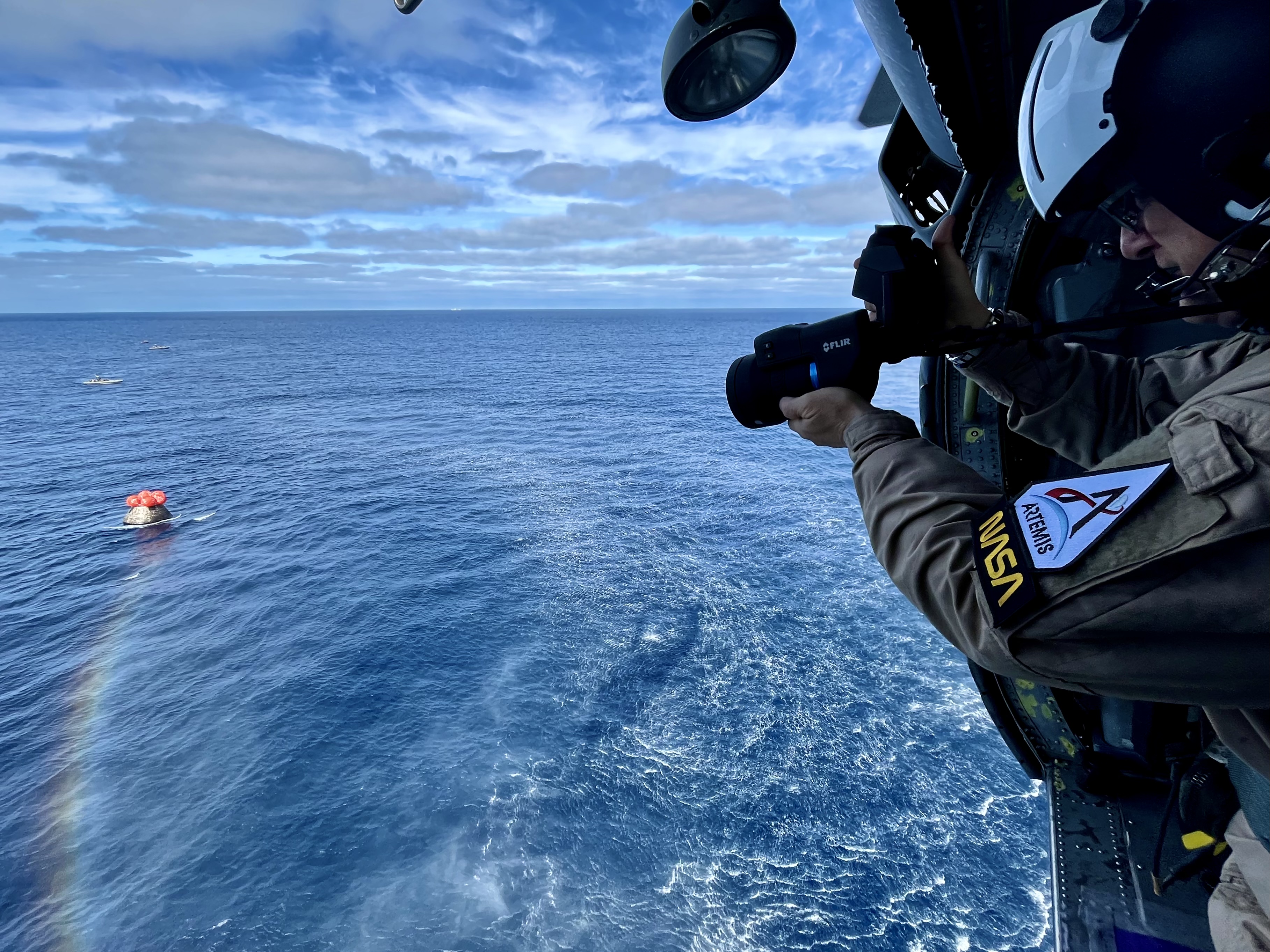
Archive photograph · 2022-12-11 · Pacific Ocean off Baja California; view from a recovery helicopter.


Understand the story.
New analysis of an April return
The fresh development is additional engineering analysis, not another Moon flight. Artemis II splashed down April 10. NASA now reports nine char-loss spots of varying sizes on its heat-shield dish, compared with 103 after Artemis I. That is a count of locations, not a measure of damaged area. [5] [1]
The path through the atmosphere changed
NASA says shortening the allowed downrange distance reduced time in the temperature range linked to Artemis I’s cracking. Its earlier investigation traced that phenomenon to gas pressure inside Avcoat. That investigation also said Artemis I’s cabin data stayed within limits; more spots alone did not establish an unsafe cabin. [2] [4]
What to check in the next safety claim
Read the assessment’s continuing-work paragraph before treating the result as final certification. NASA is comparing laser scans and continuing sample and thermal analysis. This report supplies no full spot-area dataset or future-flight failure probability, and we did not independently inspect the hardware. [3]
How we know5 scoped claims · 2 source recordsView evidence
Each claim keeps its full assertion, date, source passage and limits. Source counts describe records, not independent corroboration.
1.The reported countsSupported
NASA’s October 15 assessment reports nine char-loss spots of varying sizes on the Artemis II heat-shield dish, compared with 103 on Artemis I.
- Scope
- NASA’s October 15, 2026 post-flight assessment of Orion heat shields after Artemis I and II. Counts are char-loss spots of varying sizes on each heat-shield dish, not damaged area, damaged blocks, failure probability or an independent safety certification. The mission return occurred in April; publication of additional analysis is the fresh development.
- Evidence passage
- Post-flight assessment paragraph beginning “A thorough post-flight assessment review”; sentence “Engineers found only nine spots”.
- As of
- 2026-10-16
- Limit
- The counts do not measure affected area, severity, lost mass or the probability of harm. Each flight supplied one inspected shield; spot sizes vary.
Retrieved 2026-10-16T20:03:01.088Z · NASA Communications
NASA’s own engineering account. This run did not independently examine telemetry, inspect the hardware or reproduce material tests. Earlier background is not independent corroboration of the fresh assessment.
2.NASA’s explanationSupported
NASA attributes reduced cracking and char loss to shortening the maximum downrange distance of Artemis II’s reentry, limiting time in the temperature range associated with the Artemis I phenomenon.
- Scope
- NASA’s October 15, 2026 post-flight assessment of Orion heat shields after Artemis I and II. Counts are char-loss spots of varying sizes on each heat-shield dish, not damaged area, damaged blocks, failure probability or an independent safety certification. The mission return occurred in April; publication of additional analysis is the fresh development.
- Evidence passage
- Paragraph beginning “After NASA’s thorough analysis”; post-flight assessment paragraph.
- As of
- 2026-10-16
- Limit
- This is an attributed engineering explanation. Spot counts alone do not isolate a causal effect or establish a safety multiplier.
Retrieved 2026-10-16T20:03:01.088Z · NASA Communications
NASA’s own engineering account. This run did not independently examine telemetry, inspect the hardware or reproduce material tests. Earlier background is not independent corroboration of the fresh assessment.
3.Work continuesSupported
NASA says it is comparing post-flight laser scans with pre-flight measurements to assess material recession; sample extraction, material assessment and thermal analysis continue.
- Scope
- NASA’s October 15, 2026 post-flight assessment of Orion heat shields after Artemis I and II. Counts are char-loss spots of varying sizes on each heat-shield dish, not damaged area, damaged blocks, failure probability or an independent safety certification. The mission return occurred in April; publication of additional analysis is the fresh development.
- Evidence passage
- Paragraph beginning “The team also performed post-flight laser scans”.
- As of
- 2026-10-16
- Limit
- The article supplies no complete spot-area dataset, raw telemetry or quantified future-flight failure probability.
Retrieved 2026-10-16T20:03:01.088Z · NASA Communications
NASA’s own engineering account. This run did not independently examine telemetry, inspect the hardware or reproduce material tests. Earlier background is not independent corroboration of the fresh assessment.
4.The earlier problemSupported
NASA’s December 2024 investigation says gas unable to vent through Artemis I Avcoat built pressure and caused cracks and shedding. It also says cabin-system temperature data stayed within limits and that a crew would have been safe.
- Scope
- NASA’s October 15, 2026 post-flight assessment of Orion heat shields after Artemis I and II. Counts are char-loss spots of varying sizes on each heat-shield dish, not damaged area, damaged blocks, failure probability or an independent safety certification. The mission return occurred in April; publication of additional analysis is the fresh development.
- Evidence passage
- Findings → skip-guidance, gas pressure and permeability discussion; paragraph beginning “While Artemis I was uncrewed”.
- As of
- 2026-10-16
- Limit
- This is NASA’s earlier account, not an independently reconstructed test. Larger spot counts do not by themselves establish that Artemis I would have harmed a crew.
Retrieved 2026-10-16T20:04:44.641Z · NASA / Erika Peters
NASA’s own engineering account. This run did not independently examine telemetry, inspect the hardware or reproduce material tests. Earlier background is not independent corroboration of the fresh assessment.
5.Analysis is the developmentSupported
The new NASA account dates Artemis II splashdown to April 10, 2026 and describes later examinations, including sample extraction and internal x-ray scans beginning in August.
- Scope
- NASA’s October 15, 2026 post-flight assessment of Orion heat shields after Artemis I and II. Counts are char-loss spots of varying sizes on each heat-shield dish, not damaged area, damaged blocks, failure probability or an independent safety certification. The mission return occurred in April; publication of additional analysis is the fresh development.
- Evidence passage
- Underwater-imagery caption dated April 10, 2026; paragraph beginning “Upon the spacecraft’s return”.
- As of
- 2026-10-16
- Limit
- October 15 is the publication of additional analysis, not the date of the flight or splashdown.
Retrieved 2026-10-16T20:03:01.088Z · NASA Communications
NASA’s own engineering account. This run did not independently examine telemetry, inspect the hardware or reproduce material tests. Earlier background is not independent corroboration of the fresh assessment.
What remains open.
- NASA’s two articles are one institutional chain, not independent corroboration.
- No raw telemetry, complete spot-area dataset or independent inspection was obtained.
- Spot counts cannot quantify future astronaut risk or establish readiness of an entire future mission.
- Further scan comparisons, sample work and thermal analysis continue.
- The archive photograph is the 2022 Artemis I recovery; it does not document the reported 2026 inspections.
A corrected NASA assessment, changed count definition, released raw measurements or contradictory independent engineering record would reopen the claims, graphic and explanation.
THIS STORY IN TIME
Keep the dates with the story.
- Reported development
- Evidence as of
- First retained publication
- This version published
Publication times are Central. A development date and an evidence date can differ. Missing dates remain unrecorded.